Monday, February 27, 2012

The Not-So Emotionally Intelligent Team Lessons

I have had the pleasure to be apart of many teams growing up. One thing I have begun to recognize the importance of through my involvement on these teams is the need for emotional intelligence. Without emotional intelligence, you can have the smartest group of people, who will get nowhere and accomplish very little. The ability to understand your emotions and the emotions of others around you and then react and respond appropriately to these emotions is crucial to individual and team success.

When I was in high school, I served on the FFA officer team and unfortunately, through this experience I had my first run in with what the lack of emotional intelligence can do to a team. It destroys teams. Needless to say, being in high school probably didn’t help our emotional maturity. Many of the people on the team often did not act like the young adults they were becoming, but instead resorted to the childish ways to avoiding emotions and problems. Often time, meetings would be silent and all the work fell back on one or two individuals. We had no team identity and even though we had set forth common goals at the beginning of the year, many seemed to forget these.

Part of the reason for this division and the complete lack of emotional intelligence, I believe was due in part that there was an inter competition for the presidency of the next year. Everyone in the chapter knew that there were going to be at least 5 well-deserving candidates for the position and instead of focusing on the current team they were on these individuals turned to selfish ways to get ahead. Competition and high emotions for the upcoming year controlled the way they acted. People were going behind peoples backs, starting rumors, and being just plain mean to one another in an attempt to cut the others out of the running. The team did not communicate well and the only motivation for many of the team members was to form cliques and degrade others.

Needless to say the year turned into a long and painful emotional roller coaster ride. Not much was accomplished due to the division of the officer team and the lack of emotional intelligence. I learned a lot from the experience about the importance of emotional intelligence and how the lack of it can lead to the downfall of a team.

Wednesday, February 15, 2012

Becoming a Team

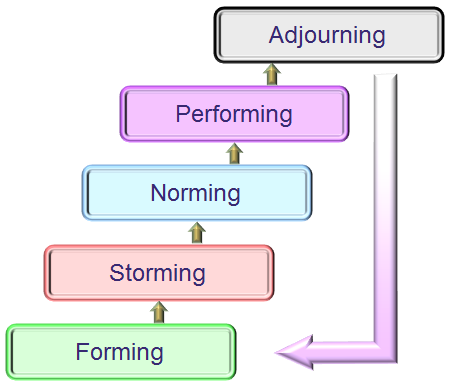
Stages of team development are extremely important and a very natural way for teams to mature and grow. One of the most famous group development models is the Tuckman and Jensen model of five stages of group development. In this model Tuckman and Jenson argue that there are five stages of group development- forming, storming, norming, performing, and adjourning. Group progress from one stage to another naturally- they can go back and forth or skip stages along the way, so the model does not always progress in a completely linear way.

A couple of years ago I had the wonderful opportunity to serve as a Virginia State officer and was on a team with 8 other teammates. For an entire year we had the responsibility to serve the Virginia FFA Association across the state and nation. As I was reviewing the Tuckman and Jenson model my year as a state officer came flooding back and I started to clearly connect the stages of the model to different parts of my state officer year.

When we were first elected, we were clearly in the forming stage. We started out talking about our likes and dislikes and really trying to get to know one another. Then we jumped over the storming stage into norming and performing. We started establishing rules and setting forth expectations for the year so we were all on the same page. As we continued to establish our norms we started planning workshops, doing visits, going to conferences and such. Then when we attended National Convention we reverted back to the storming stage we had skipped. Tension rose within the team and people started getting frustrated and letting their disagreement with others actions and decisions show. Once that was all out we continued through cycles the entire year of performing and then storming. We would go for long periods of time really getting things accomplished and then we would spend a weekend together and the claws would come out again. However, I believe this cycle is what allowed us to be so productive and accomplish what we did. We started with a solid foundation and then developed our norms from there and our cycle of performing and storming made sure we were open and putting it all on the table in the best possible manner. Our year together ended as quickly as it began. A simple tap of the gavel dismissed us from our duties and the organization moved on with new leadership as we adjourned and turned our roles over to others. It was undoubtedly an incredible experience and I believe that year taught me more than I ever imagined possible. I can now look at models like the Tuckman and Jenson model among other leadership models, terms, and theories, and clearly make connections to a real- hand on experience of mine.

Sunday, February 5, 2012

Groups vs. Teams

Teams vs. groups… what is the difference? I can’t even begin to tell you the number of times I have been divided into a group or been asked to be a part of team. I never really fully understood the difference between to two until recently and I believe most people are still puzzled by the difference. Groups are larger and they tend to not be as focused as team’s are- normally they have a common interest and communicate about that interest. Teams on the other hand tend to be smaller than groups and often times have a very specific goal they want to achieve and as a result work together closely to attain that goal. Teams have an investment in success. SO, what does this mean for us as members of different groups and teams?

Throughout my lifetime I have had the chance to serve on many teams and be apart of many groups. When I was younger, I was apart of my Girl Scout troop. Every other week would meet and have a great time getting together and working on our lessons and doing crafts. We were a group of girls with similar interests in community service and growth but we were not really a team. Yes, we had a great time going to events and sometimes planning activities, but we had no real investment in success and we never relied on one other to do certain jobs to attain our goals (mainly because we had no clearly defined goals, just common interests). Needless to say I learned a lot through my involvement with the girl scouts and it was nice to be apart of a group at a younger age.

As I grew older, I started to learn what it meant to be a team. When I was in high school I ran varsity cross country and track my freshman year until a knee injury ended in two surgeries and untimely ended my high school running career. When I was on the cross-country team, it was different. We weren’t just a group of high school students who got together for fun; we were a team who worked together. We ran together, we shared together, we grew together, we lost together, and we won together. Each of us had a part and we each had a responsibility to uphold our end of the deal. We had a common goal and in the process of accomplishing that goal we became good friends and built our social relationships. We woke up early and stayed up late; we leaned on each other for support and in the process each of grew as people and as a team. Six other girls plus me, showed mw for the first time what it truly meant to be apart of a team and to be apart of something larger than just me.

Now that I have reflected on some of my experiences in groups and teams I feel better equipped to understand where they are appropriate and how to use them. As youth leaders it is important for us to understand the difference between groups and teams. We need to be able to define our experiences and use them to help us better understand the similarities and difference between these.